
Disclosure: This article may contain affiliate links. If you buy through them, we may earn a small commission at no extra cost to you. We only recommend gear we believe is genuinely useful for travelers to Japan.
In a hurry? The short answer:
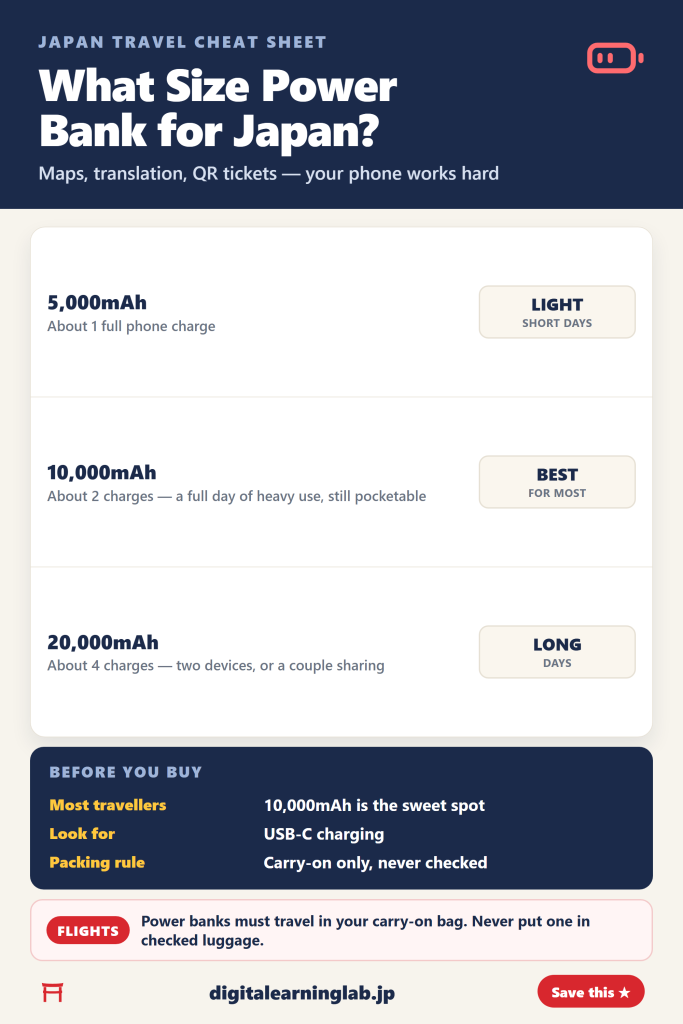
- Most travelers: a 10,000mAh power bank — one full day of heavy use, still pocketable
- Light packers / short days: 5,000mAh is enough
- Long days, two phones, or sharing: 20,000mAh
- Look for: USB-C, and keep it in your carry-on (never checked luggage)
In Japan, your phone is your lifeline — maps to navigate the stations, translation to read menus, your eSIM for data, and QR codes for train tickets and attractions. All of that drains your battery fast, and running out of power halfway through a day of sightseeing is genuinely stressful. A good power bank fixes that. This guide explains exactly what capacity and features you need for a Japan trip, so you can pick the right one with confidence.
Getting your phone travel-ready? Pair this with our best eSIM for Japan guide so you land online, and see our what to pack for Japan guide for the rest of your essentials.
Why you’ll drain your battery faster in Japan
It’s easy to underestimate how much you’ll use your phone in Japan. A typical day of sightseeing involves a surprising amount of screen time:
- Google Maps, all day. Navigating Japan’s dense train networks and neighborhoods keeps your GPS and screen working hard — one of the biggest battery drains there is.
- Translation apps. Pointing your camera at menus and signs, or using voice translation, adds up over a day.
- Your eSIM & mobile data. Constant connectivity is what makes a trip smooth, but it keeps the radio active.
- Photos and videos. Japan is endlessly photogenic — you’ll shoot far more than you expect.
- QR codes and mobile tickets. More and more trains, tours, and attractions rely on your phone to get you through the gate.
Put together, that’s easily enough to flatten most phones by mid-afternoon. A power bank turns “my battery’s at 12%, I need to find a cafe” into a non-issue.
What capacity do you actually need?
Power banks are rated in mAh (milliamp-hours) — roughly, how much charge they hold. Here’s how the common sizes translate to a Japan trip.
| Capacity | Roughly gives you | Best for |
|---|---|---|
| 5,000mAh | About 1 full phone charge | Light users, short days, minimalists |
| 10,000mAh | About 2 charges | Most travelers — the sweet spot |
| 20,000mAh | About 4 charges | Long days, two devices, couples sharing |
Our recommendation for most people: 10,000mAh. It reliably gets a heavy-use phone through a full day of maps, photos, and translation with charge to spare, yet it’s still small and light enough to sit in a jacket pocket or the front of a daypack. 5,000mAh is fine if you travel light and don’t stream, while 20,000mAh is worth the extra weight only if you’re out from dawn to midnight, carrying two phones, or sharing with a travel partner.
Features that matter for a Japan trip
Beyond capacity, a few features make a real difference on the road:
- USB-C (in and out). Modern phones charge over USB-C, and a USB-C power bank recharges faster too. Look for USB-C as the primary port so you can travel with a single cable.
- Fast charging (PD / Power Delivery). A power bank that supports USB-C Power Delivery tops your phone up quickly during a coffee stop, instead of trickling slowly.
- Light and pocketable. You’ll carry this all day, every day. Weight and size matter more than an extra few thousand mAh you won’t use.
- MagSafe / magnetic (iPhone users). A magnetic power bank that snaps to the back of a recent iPhone lets you keep using your phone while it charges — handy when you’re navigating and topping up at the same time.
- Pass-through charging. Some banks can charge your phone while they themselves are plugged in — useful for overnight top-ups in a small hotel room with one outlet.
Important: power banks and flights
This trips up a lot of travelers, so it’s worth stating clearly. Power banks (lithium batteries) must go in your carry-on bag, never in checked luggage — this is an international aviation safety rule, so it covers your flights to and from Japan.
- Most airlines allow power banks up to 100Wh without special approval. A 20,000mAh bank is typically around 74Wh, so standard travel sizes (5,000–20,000mAh) are fine.
- Keep it in your carry-on or personal item, not your checked suitcase.
- If a capacity is printed in mAh but not Wh, you’re almost certainly under the limit at these sizes — but check your airline’s page if you’re carrying something unusually large.
One more Japan-specific note: a recent local trend has seen some venues ask that power banks not be used while packed away, so just keep yours accessible in your daypack rather than buried at the bottom.
Should you buy before you fly, or in Japan?
For a power bank, buy it before you fly. You’ll want it working from the moment you land — navigating out of the airport is exactly when your battery anxiety starts. Buying at home also lets you choose from your own country’s range and have it charged and ready in your carry-on.
Japan does sell excellent power banks, and convenience stores even offer rental banks in a pinch, but relying on finding one after a long flight (while your phone is dying and you’re navigating an unfamiliar station) is the opposite of stress-free. Sort it out in advance.
Staying online, too? A power bank keeps your phone charged, but you’ll still need mobile data. Our eSIM vs pocket WiFi guide compares the two side by side, and our comparison of Airalo, Ubigi and Klook eSIMs walks you through the plans.
Frequently asked questions
What size power bank is best for Japan?
For most travelers, 10,000mAh is the sweet spot — about two full phone charges, while staying light and pocketable. Go 5,000mAh if you travel very light, or 20,000mAh for long days or sharing.
Can I bring a power bank on the plane to Japan?
Yes, in your carry-on only (never checked luggage). Standard travel sizes up to about 100Wh are allowed by most airlines, which covers 5,000–20,000mAh banks.
Do I need a plug adapter to charge it in Japan?
Japan uses Type A outlets (the same two flat pins as North America). Many travelers from the US and Canada won’t need an adapter; travelers from the UK, EU, and Australia will. Charge your power bank overnight and use it during the day.
Is a power bank or pocket WiFi more important?
They solve different problems — a power bank keeps your phone alive, while data (an eSIM or pocket WiFi) keeps it connected. For most solo travelers, an eSIM plus a 10,000mAh power bank is the ideal combo.
Final thoughts
A power bank is small and cheap, and it saves you from hunting for an outlet halfway through the day. For most travelers, a lightweight 10,000mAh bank with USB-C is enough. Buy it before you fly and charge it the night before you leave. It goes in your carry-on bag.
Quick pick: A 10,000mAh USB-C power bank suits most travelers. Keep it in your carry-on, and pair it with an eSIM so your phone stays both charged and connected.