
Disclosure: This article may contain affiliate links. If you buy through them, we may earn a small commission at no extra cost to you. We only recommend gear we believe is genuinely useful for travelers to Japan.
In a hurry? The short answer:
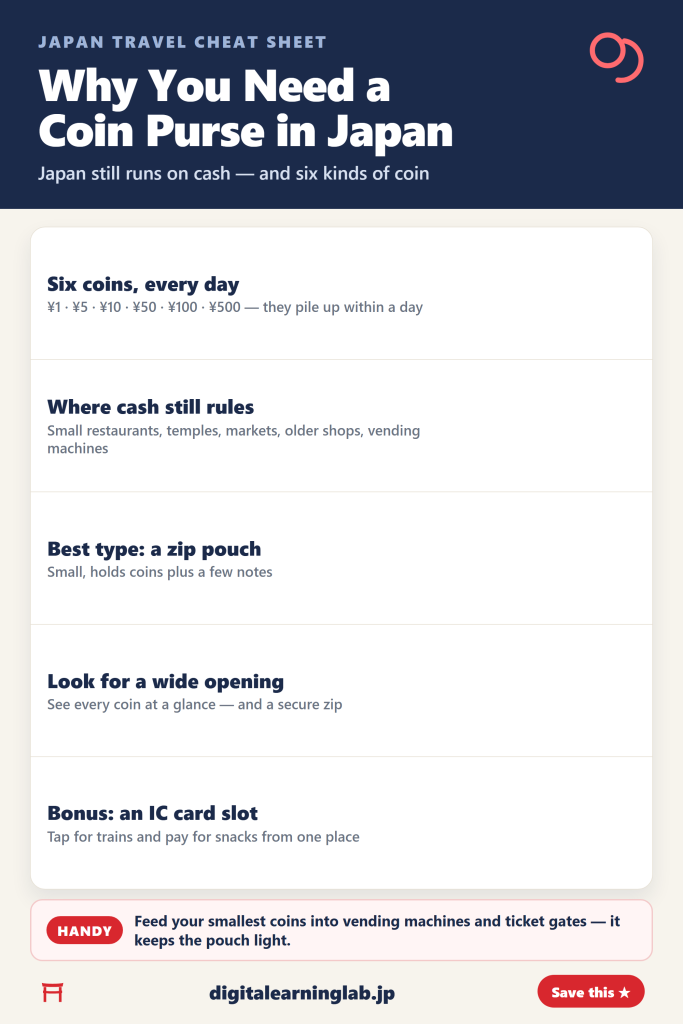
- Do you need a coin purse? Yes — Japan still uses a lot of cash, and you’ll collect a pocketful of coins fast
- Best type: a small zip pouch that holds coins and a few notes
- Look for: a wide opening so you can see coins at a glance, and a secure zip
- Bonus: keep your IC card in a slot so you tap and pay from one place
Japan is famously high-tech, so first-time visitors are often surprised by one thing: it’s still very much a cash-and-coin country. Small restaurants, temples, markets, older shops, and vending machines frequently want physical money — and Japanese coins come in six denominations, so you’ll accumulate a jingling pocketful within a day or two. A small coin purse keeps those coins in one place. Here’s why it’s a genuine Japan travel essential, and what to look for.
Sorting out how you’ll pay in Japan? Read this alongside our guide to Suica, Pasmo & IC cards — together they cover almost every way you’ll pay on your trip.
Why you’ll end up with a pocketful of coins in Japan
Even as card and IC-card payments grow, cash remains everywhere in Japan — and that means coins. There are a few reasons your change adds up fast:
- Six coin denominations. Japan uses 1, 5, 10, 50, 100, and 500 yen coins. The 500 yen coin is worth several dollars, so a handful of coins can add up to real money.
- Lots of cash-only spots. Small eateries, street food, temples and shrines, local markets, and some older shops still prefer or require cash.
- Vending machines and lockers. Japan’s ubiquitous vending machines and coin lockers run on coins (and small notes).
- Exact change is appreciated. Paying with coins keeps you from breaking another note and collecting even more change.
Without a dedicated purse, all of this ends up loose in your pockets or rattling around your bag — easy to lose, slow to count, and awkward at the register. A coin purse fixes all three.
Do you really need a coin purse for Japan?
Honestly — yes, for most travelers. If you’re paying for everything by phone or card and never touch cash, you can skip it. But that’s rare in Japan: sooner or later you’ll hit a cash-only ramen counter, a shrine offering box, or a vending machine, and you’ll be glad to have your coins organized. It’s a tiny, cheap item that removes a small daily friction, which is exactly what good travel gear should do.
It also pairs neatly with going cashless where you can. Use an IC card for trains, buses, and convenience stores to cut down on change in the first place, and keep a coin purse for the cash-only moments that remain.
What to look for in a coin purse for Japan
These are the features that help most on a Japan trip:
- A wide opening. The best travel coin purses open wide — a zip-around or a clasp that lets you see all your coins at once, so you can grab the right ones quickly at the register.
- Room for a few notes too. A purse that also holds a couple of folded banknotes means you can leave your main wallet safe at the hotel and carry just the day’s cash.
- A secure zip. Coins are heavy and slip out of open pouches. A reliable zip keeps your 500 yen coins where they belong.
- Compact and light. It should fit easily in a pocket or the front of your daypack.
- An IC card slot (bonus). Some coin purses include a card slot or pass sleeve. Keeping your IC card there means you tap in, tap out, and pay for coins all from one small pouch.
A few smart ways to handle cash and coins in Japan
Beyond the purse itself, a couple of habits make cash in Japan easier to manage:
- Use coins first. At the register, pay with coins before notes to keep your change from snowballing. Many Japanese registers even have a coin tray to make this easy.
- Feed coins into vending machines and lockers. It’s a painless way to spend down your heavier coins during the day.
- Withdraw cash at 7-Bank ATMs. Convenience-store ATMs reliably accept foreign cards — top up your cash there rather than hunting for a bank.
- Go cashless where you can. Lean on your IC card and cards for everyday spending, and reserve coins for the cash-only spots.
Should you buy before you fly, or in Japan?
Either works, but buying before you fly means you land organized — no fumbling with loose coins on day one. That said, Japan sells wonderful coin purses, from simple practical pouches to beautiful traditional gamaguchi clasp purses that also make a lovely souvenir. Many travelers bring a plain one for the trip and pick up a pretty Japanese one along the way.
Need yen when you land? Our Narita & Haneda to Tokyo guide notes which airport ATMs accept foreign cards and helps you pick the best way into the city for where you’re staying.
Frequently asked questions
Is Japan still a cash country in 2026?
Card and IC-card payments are growing fast, but cash is still widely used — especially at small restaurants, temples, markets, and vending machines. Carry some cash and coins even if you mostly pay by card.
How much cash should I carry in Japan?
A common approach is to carry enough for a day or two of small purchases and top up at convenience-store ATMs as needed. You’ll rely on cash more for small, local, and traditional spots.
Can’t I just use my IC card or phone instead?
For trains, buses, and convenience stores, yes — an IC card handles a lot. But enough places are cash-only that you’ll still want coins organized in a purse.
Final thoughts
A coin purse is one of those tiny, inexpensive items that quietly makes a Japan trip smoother. Between the six coin denominations and all the cash-only moments, you’ll be handling coins daily — and having them organized in a small, wide-opening purse (ideally with a slot for your IC card) means you pay quickly and never lose a valuable 500 yen coin. Pack one before you fly, and use your IC card for trains and convenience stores so fewer coins pile up.
Quick pick: A small, wide-opening zip coin purse that also holds a few notes — bonus points for an IC card slot. Pair it with an IC card to keep everyday spending cashless.