
Disclosure: This article contains affiliate links. If you buy through them, we may earn a small commission at no extra cost to you. We only recommend services we believe are genuinely useful for travelers to Japan.
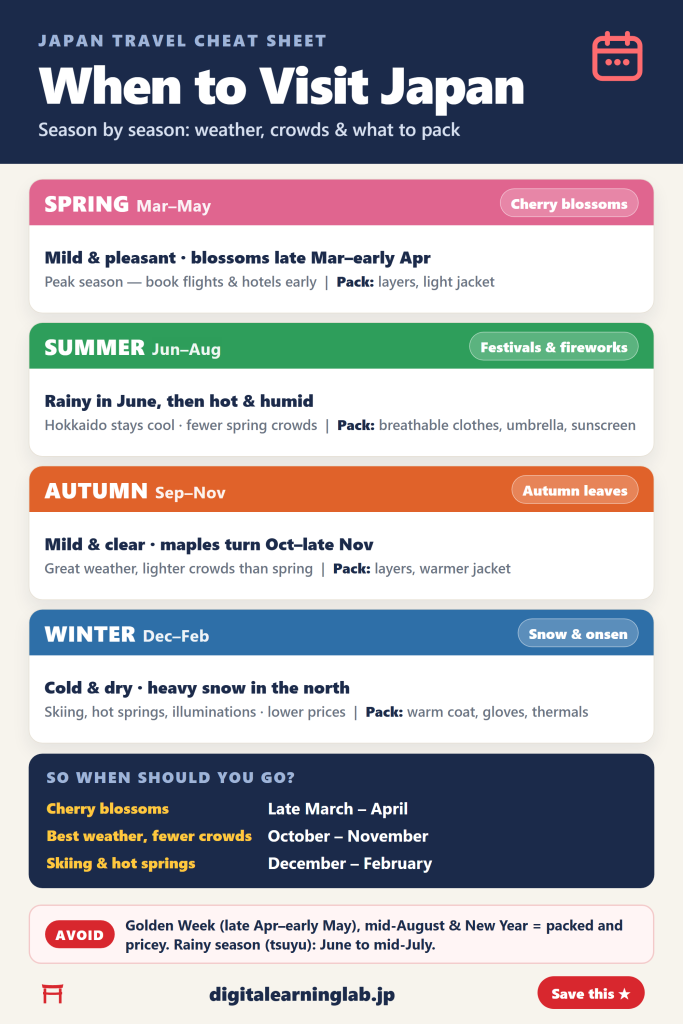
In a hurry? The best time to visit Japan at a glance:
- Cherry blossoms: late March to April
- Best weather & fewer crowds: October to November (autumn)
- Festivals: July to August
- Snow & hot springs: December to February
- Cheapest & quietest: avoid cherry-blossom season & Golden Week
Japan is a year-round destination, but the season you choose shapes your entire trip — from the scenery and the crowds to what you’ll need to pack. Cherry blossoms in spring, cool temples in summer, fiery autumn leaves, and snowy hot springs in winter each offer something completely different. This guide walks through every season so you can pick the best time to visit Japan for your trip, and pack for it with confidence.
Japan’s four seasons at a glance
| Season | Weather | Known for |
|---|---|---|
| Spring (Mar–May) | Mild, pleasant | Cherry blossoms |
| Summer (Jun–Aug) | Hot & humid, rainy early | Festivals, fireworks |
| Autumn (Sep–Nov) | Mild, clear | Autumn leaves |
| Winter (Dec–Feb) | Cold, dry, snowy north | Snow, hot springs, skiing |
Spring (March–May): cherry blossom season
Spring is the most popular time to visit Japan. Temperatures are mild, and from late March into April the famous cherry blossoms bloom in waves across the country. It’s also peak season: flights, hotels, and popular spots get busy and expensive, so book well in advance.
Best for: first-time visitors, photographers, and anyone who wants that classic pink-blossom Japan experience. Pack: layers, a light jacket, and comfortable walking shoes.
The blossoms typically reach Tokyo and Kyoto around late March to early April, moving northward as the weeks pass — so if you miss them in one region, you may catch them further north. Beyond the flowers, spring is simply a lovely time to explore gardens, parks, and temples in comfortable weather.
Summer (June–August): festivals and green landscapes
Summer starts with a rainy season in June, then turns hot and humid through July and August. It’s the least comfortable weather-wise, but it’s also the season of vibrant festivals (matsuri), spectacular fireworks displays, and lush green countryside. Northern regions like Hokkaido stay cooler and are a great summer escape.
Best for: festival-goers, budget travelers avoiding spring crowds, and Hokkaido trips. Pack: breathable clothing, a compact umbrella, sunscreen, and a reusable water bottle.
Autumn (September–November): autumn leaves
Many seasoned travelers consider autumn the best time to visit Japan. The heat fades, skies are clear, and from October into late November the maple leaves turn brilliant shades of red and gold. Crowds are lighter than spring, making it a fantastic balance of beauty and comfort.
Best for: travelers who want great weather, stunning scenery, and smaller crowds. Pack: layers and a warmer jacket for the later weeks.
Kyoto’s temples are especially breathtaking framed by red maples, and the colors sweep south through the country from October into December. Because the weather is comfortable and the crowds thinner than spring, autumn is a favorite for repeat visitors and anyone who wants long days of sightseeing without the heat.
Autumn is also the tastiest season to visit — see our guide to autumn food in Japan for the seasonal flavors to try.
Winter (December–February): snow and hot springs
Winter is cold and dry, with heavy snowfall in the north and along the Sea of Japan. It’s the season for world-class skiing in places like Hokkaido and Nagano, steaming outdoor hot springs (onsen), and beautiful illuminations. Central and southern cities like Tokyo and Kyoto are chilly but very manageable.
Best for: skiers, onsen lovers, and travelers seeking fewer crowds and lower prices. Pack: a warm coat, gloves, a hat, and thermal layers.
So when is the best time to visit Japan?
There’s no single answer — it depends on what you want:
- Cherry blossoms & classic scenery? Late March to April (spring).
- Best overall weather with fewer crowds? October to November (autumn).
- Festivals & a lively atmosphere? July to August (summer).
- Snow, skiing & hot springs? December to February (winter).
- Lower prices & smaller crowds? Avoid cherry blossom season and Japan’s domestic holidays.
Don’t forget: Japan is long and varied
One thing surprises many first-time visitors — Japan stretches thousands of kilometers from north to south, so “the weather in Japan” varies enormously at any given time. In winter, Hokkaido in the north can be deep in snow while Okinawa in the south stays mild enough for a light jacket. In summer, the main cities are hot and humid while the northern highlands stay pleasant.
The practical takeaway: don’t pack for a single climate. Check the forecast for each destination on your itinerary and bring adjustable layers so you’re comfortable wherever your trip takes you.
What to pack for Japan (any season)
Some essentials apply no matter when you visit:
- Comfortable walking shoes. You’ll walk far more than you expect — through stations, temples, and neighborhoods.
- A coin purse or small wallet. Japan still uses a lot of coins, and they add up fast.
- A portable charger. Long days of maps, photos, and translation drain your phone quickly — see our guide to the best power banks for Japan to pick the right capacity.
- Mobile data. An eSIM keeps you online from the moment you land — see our best eSIM for Japan guide.
- A small daypack. Handy for day trips, since public bins are scarce and you’ll often carry your own trash and layers.
- Cash and a travel-friendly card. Many places take cards, but some smaller shops and rural spots are cash-only.
Once you’ve picked your season and packed, the last piece is getting from the airport into the city — our Narita & Haneda to Tokyo guide covers every option.
Book seasonal tours & tickets →
Frequently asked questions
What is the rainiest time in Japan?
The rainy season (tsuyu) runs roughly through June into mid-July across most of the country, though Hokkaido is largely unaffected. Pack a compact umbrella if you visit then.
When should I avoid visiting for crowds?
Japan’s domestic holiday periods — such as the late-April to early-May “Golden Week,” mid-August, and New Year — see heavy local travel, higher prices, and packed transport. If you can, plan around them.
Do I need different clothes for different regions?
Yes. Japan stretches a long way north to south, so Hokkaido can be snowy while Okinawa is mild. Check the forecast for each place on your itinerary and pack layers you can adjust.
Final thoughts
Pick the season based on what you want to see and do. Choose spring for blossoms, autumn for comfort and color, summer for festivals, or winter for snow and onsen. If you’re going in cherry blossom season, book flights and hotels early. Whatever the season, sort out your mobile data and airport transfer before you fly.
Quick pick: Best weather + fewer crowds? Go in autumn. Want cherry blossoms? Go late March–April and book early.