
Disclosure: This article contains affiliate links. If you buy through them, we may earn a small commission at no extra cost to you. We only recommend services we believe are genuinely useful for travelers to Japan.
Once you land in Japan, the first thing to sort out is getting from the airport to Tokyo’s city center. It sounds simple, but Narita and Haneda are very different distances from the city, and the “best” option depends on your budget, your luggage, and where your hotel is. This guide breaks down every realistic choice so you can walk off the plane knowing exactly what to do.
First, a quick tip that saves a lot of stress: set up your mobile data before you leave the airport so you can navigate, buy tickets, and check train times on the go. If you haven’t sorted that yet, see our guide to the best eSIM for Japan.
Narita vs Haneda: know which airport you’re at
Tokyo has two airports, and they’re not equally convenient:
- Narita Airport (NRT) is about 60–70 km east of central Tokyo. Getting in takes roughly 60–90 minutes depending on the option you choose.
- Haneda Airport (HND) is much closer — just 15 km south of the city. You can be in central Tokyo in as little as 15–30 minutes.
Check your ticket to see which one you’re arriving at, because the routes are completely different. We’ll cover both below.
Getting from Narita Airport to Tokyo
Narita is farther out, so this is where choosing the right option matters most. Here are your four realistic choices.
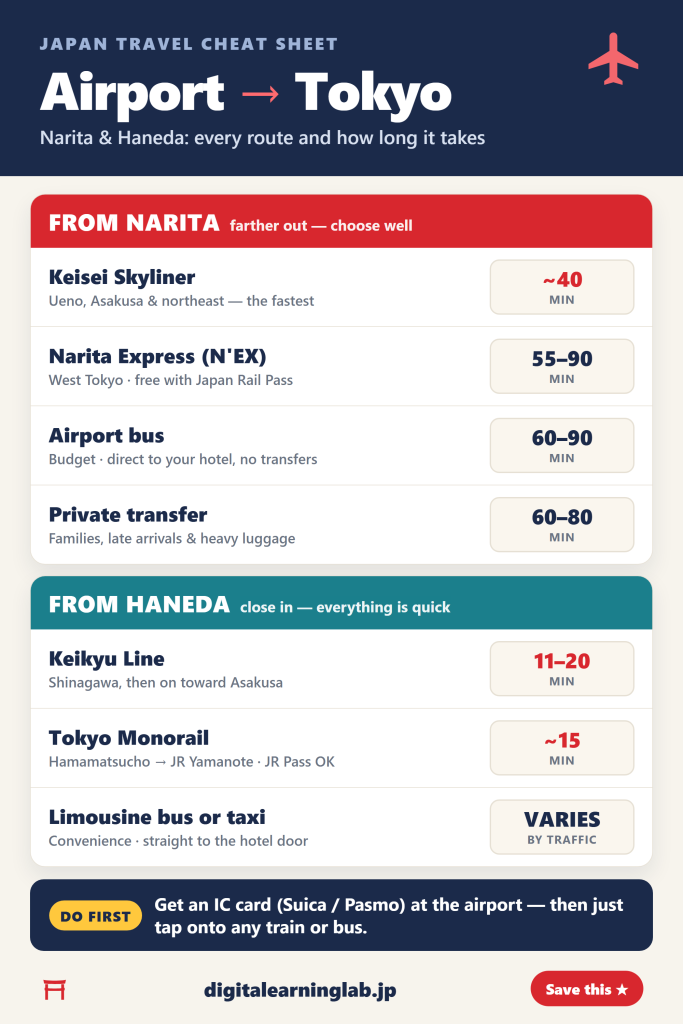
1. Narita Express (N’EX) — best for west Tokyo
The Narita Express is a comfortable JR train that runs directly to major hubs like Tokyo Station, Shinjuku, Shibuya, and Yokohama. It takes roughly 55–90 minutes depending on your destination, with reserved seats and plenty of luggage space. It’s the most convenient option if your hotel is on the west side of the city — and if you have a Japan Rail Pass, it’s included at no extra cost.
2. Keisei Skyliner — best for east/northeast Tokyo
The Skyliner is the fastest train into the city, reaching Nippori and Ueno in around 40 minutes. If your hotel is near Ueno, Asakusa, or the northeast side of Tokyo, this is usually your quickest and best-value choice. Discounted tickets for tourists are widely available online in advance.
3. Airport bus — best for budget and direct hotel drop-off
Limousine and shuttle buses run from Narita to Tokyo Station, Ginza, and many major hotels. They’re often the cheapest option and let you avoid changing trains with heavy luggage — a real plus after a long flight. The trade-off is that travel time depends on traffic, so allow extra time.
4. Taxi or private transfer — best for comfort and groups
A regular taxi from Narita is expensive and can take well over an hour. However, a pre-booked private transfer can be worth it if you’re arriving late, traveling with family, or carrying lots of luggage — you’re met at arrivals and driven straight to your door with no navigation required.
Book Narita transport & tickets →
| Option | Time | Best for |
|---|---|---|
| Narita Express | ~55–90 min | West Tokyo, JR Pass holders |
| Keisei Skyliner | ~40 min | Ueno, Asakusa, speed |
| Airport bus | ~60–90 min | Budget, direct to hotel |
| Private transfer | ~60–80 min | Families, late arrivals |
Getting from Haneda Airport to Tokyo
Haneda is close to the city, so almost every option is fast and affordable. Here’s what to know.
1. Tokyo Monorail — best for the JR loop
The Tokyo Monorail connects Haneda to Hamamatsucho Station in about 15 minutes, where you transfer to the JR Yamanote Line that loops around central Tokyo. It’s fast, cheap, and covered by the Japan Rail Pass — a great default choice.
2. Keikyu Line — best for Shinagawa and Asakusa
The Keikyu Line runs from Haneda to Shinagawa in around 11–20 minutes and continues toward Asakusa and beyond. If your hotel is near those areas, this is often the smoothest single-train route.
3. Limousine bus or taxi — best for convenience
Airport buses run directly to major hotels and districts, and because Haneda is close, a taxi to central Tokyo is far more affordable than from Narita. Both are good options if you’re tired or have heavy bags.
Get an IC card before you ride
Whatever route you take, your Tokyo trip will be far smoother with a rechargeable IC card (such as Suica or Pasmo). You simply tap it on train and bus readers instead of buying a ticket each time, and you can also use it at convenience stores and vending machines.
Tourists can pick one up at the airport, and prepaid tourist versions are designed specifically for short visits. If you have a compatible phone, you can also add a digital IC card to your mobile wallet and top it up with a card — no physical card needed. Grab one before your first ride and you’ll skip a lot of ticket-machine confusion.
Not sure which IC card to get? Our Suica, Pasmo & IC card guide compares Welcome Suica, Tourist Pasmo, and Mobile Suica so you can pick the right one.
Which option should you choose?
Here’s the simplest way to decide:
- At Narita, hotel in west Tokyo (Shinjuku/Shibuya)? Take the Narita Express.
- At Narita, hotel near Ueno/Asakusa? Take the Keisei Skyliner.
- At Narita on a tight budget? Take the airport bus.
- Arriving late, with family, or lots of luggage? Book a private transfer.
- At Haneda? The Monorail or Keikyu Line will get you into the city fast and cheap.
Frequently asked questions
Is the Japan Rail Pass worth it for the airport?
If you already have a JR Pass, both the Narita Express and the Tokyo Monorail are included, so use them. If you don’t, buy the pass only if you plan longer-distance JR travel later in your trip — it’s not worth it just for the airport ride.
Can I use my IC card straight from the airport?
Yes. Once you have a Suica, Pasmo, or a tourist IC card, you can tap onto most trains and buses immediately, including from the airport into the city.
What if I arrive late at night?
Trains stop running around midnight. If you land late, check the last train time for your route — and if you’ve missed it, a pre-booked transfer or taxi is the safest bet, especially from Narita.
Should I buy tickets in advance?
For the Skyliner and Narita Express, buying discounted tickets online in advance can save money and time, letting you skip the ticket counter and head straight to the platform after you land.
5 tips to make your airport arrival smoother
A few small preparations make a big difference when you’re tired and jet-lagged:
- Have your hotel address saved offline — in Japanese if possible. It makes buying the right ticket or telling a driver where to go far easier.
- Withdraw some cash at the airport. Japan is increasingly card-friendly, but a few small vendors, buses, and machines are still cash-only. Airport ATMs at 7-Bank and the post office reliably accept foreign cards.
- Know your last train time if you’re arriving in the evening, so you don’t get stranded and forced into an expensive late-night taxi.
- Travel light through the station. Tokyo stations have stairs and crowds; if your bags are heavy, a direct bus or transfer beats hauling luggage through multiple train changes.
- Book time-sensitive tickets before you fly. Reserved-seat trains like the Skyliner and Narita Express can sell out at peak times, and advance online tickets are often cheaper.
Final thoughts
From Narita, match the train to your hotel’s location, or book a transfer if you’d rather not deal with trains after a long flight. From Haneda, the Monorail or Keikyu Line gets you into the city quickly. Set up your mobile data before you leave the airport and pick up an IC card there, and you’re ready for your first ride.
In a hurry? Narita → west Tokyo: Narita Express. Narita → Ueno/Asakusa: Skyliner. Haneda → anywhere central: Monorail or Keikyu. Tired or with family: book a private transfer.